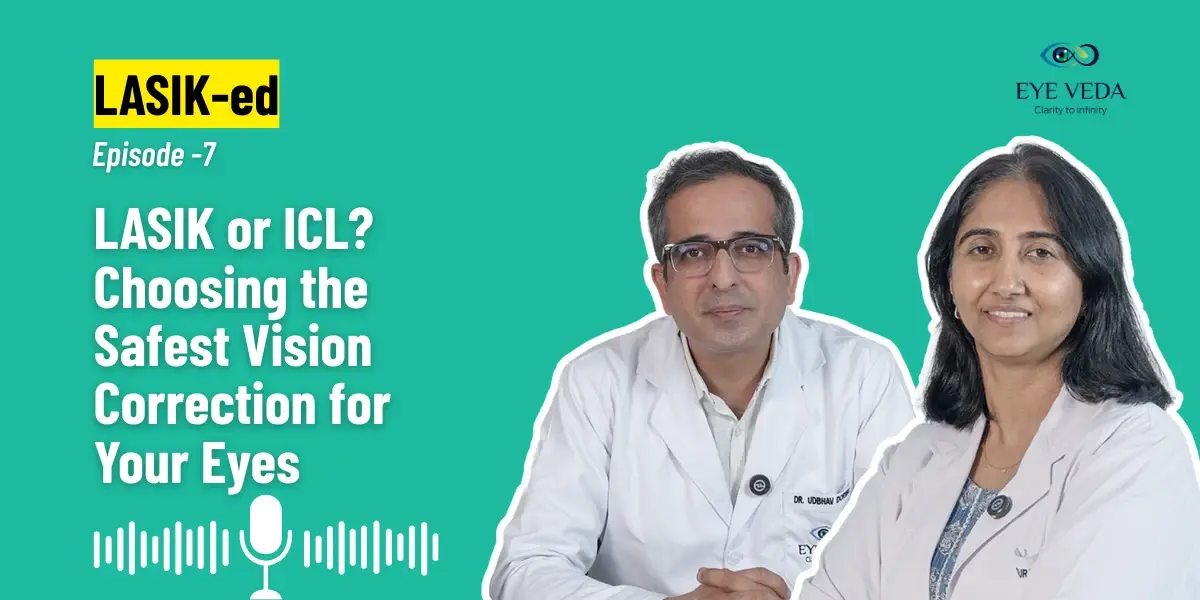
Many patients want freedom from spectacles but aren’t suitable candidates for LASIK. This expert discussion explains why some people aren’t fit for LASIK, what safe alternatives exist (most importantly ICL — Implantable Collamer Lens), and how specialists decide the best, customised option for each eye.
Side-by-side: LASIK vs ICL vs Glasses/Contact Lenses
| Topic | LASIK (Laser in situ keratomileusis) | ICL (Implantable Collamer Lens) | Glasses / Contact Lenses |
|---|---|---|---|
| How it corrects vision | Reshapes cornea with laser | Inserts corrective lens inside the eye (no corneal reshaping) | External correction — no surgery (contacts) |
| Best for | Low–moderate prescriptions; adequate corneal thickness | High prescriptions or thin/irregular corneas; patients wanting reversible surgical correction | Any prescription; those avoiding surgery |
| Cornea involvement | Yes — tissue removed/reshaped | No — cornea preserved | No |
| Reversibility | Permanent (enhancements possible) | Often reversible (lens can be removed/replaced) | Fully reversible (non-surgical) |
| Surgery complexity | Quick outpatient laser procedure | Intraocular procedure — slightly more invasive than LASIK | Non-surgical; contact lens care required |
| Recovery | Very fast (most resume normal activity within days) | Fast — may need short recovery and follow-ups | Immediate (no recovery) |
| Typical candidates | Healthy corneas, stable refraction | High myopia/hyperopia, thin corneas, unsuitable for LASIK | Anyone who accepts non-surgical solution |
| Risks / considerations | Corneal weakening if mis-selected | Intraocular surgery risks (discussed during counselling) | Infection risk with contact lens use if mishandled |
Why some patients are not fit for LASIK
LASIK requires a cornea of sufficient thickness and a shape that can safely be reshaped. Patients may be ruled out because of:
-
Very high refractive error (very high myopia/hyperopia).
-
Thin or irregular corneas (risk of weakening the cornea).
-
Corneal topography signs that indicate instability or keratoconus risk. When LASIK is unsafe or not recommended, surgeons discuss alternatives that remove or reduce dependency on glasses while protecting long-term eye health.
The main alternative: ICL (Implantable Collamer Lens)
ICL is a lens implanted inside the eye (in front of the natural lens) that corrects refractive error without altering the cornea. It’s a widely used option for patients who are not suitable for corneal laser surgery.
Why surgeons recommend ICL:
-
It treats very high prescriptions (examples include high minus powers) that LASIK cannot safely correct.
-
Cornea untouched — good option when corneal thickness is insufficient for laser ablation.
-
Reversible in many cases (the lens can be removed/changed by the surgeon).
-
High visual quality and fast recovery for appropriate candidates.
How specialists decide — the personalised approach
-
Detailed testing (e.g., corneal topography, pachymetry, endothelial cell count, anterior chamber depth) determines suitability for LASIK or ICL.
-
Customised plan: sometimes one eye may be suitable for LASIK and the other for ICL — surgeons may combine technologies for the safest, best vision outcome.
-
Education & counselling: patients are advised to research reputable sources and then discuss their case again with the specialist to clear doubts. Random online videos are rarely a reliable substitute for personalised medical advice.
What to expect if you’re told you aren’t fit for LASIK
-
It’s not a “no forever” — it’s a safety-based decision to protect your vision.
-
The team will explain what alternative fits you (ICL, contacts, or spectacles).
-
You’ll get time to research and return with questions — specialists welcome follow-up consultations to explain pros/cons and safety nets.
Practical guidance for patients
-
Get a full workup — accurate measurements and specialist interpretation matter.
-
Ask about ICL criteria — not everyone fits ICL either, but many high-power patients do.
-
Avoid blanket claims — a friend’s surgery may not apply to your eyes. Treatment is customised.
-
Request a one-on-one counselling session to discuss long-term outcomes and possible combinations (e.g., LASIK one eye + ICL the other).
Expert takeaways from Eye Veda
-
There are multiple safe options beyond LASIK; ICL is a dependable alternative for many high-power or thin-cornea patients.
-
The right choice is individualised — based on detailed diagnostics and a specialist’s judgement.
-
If told you’re not suitable for one procedure, that recommendation protects you and opens the discussion to better-suited options.