

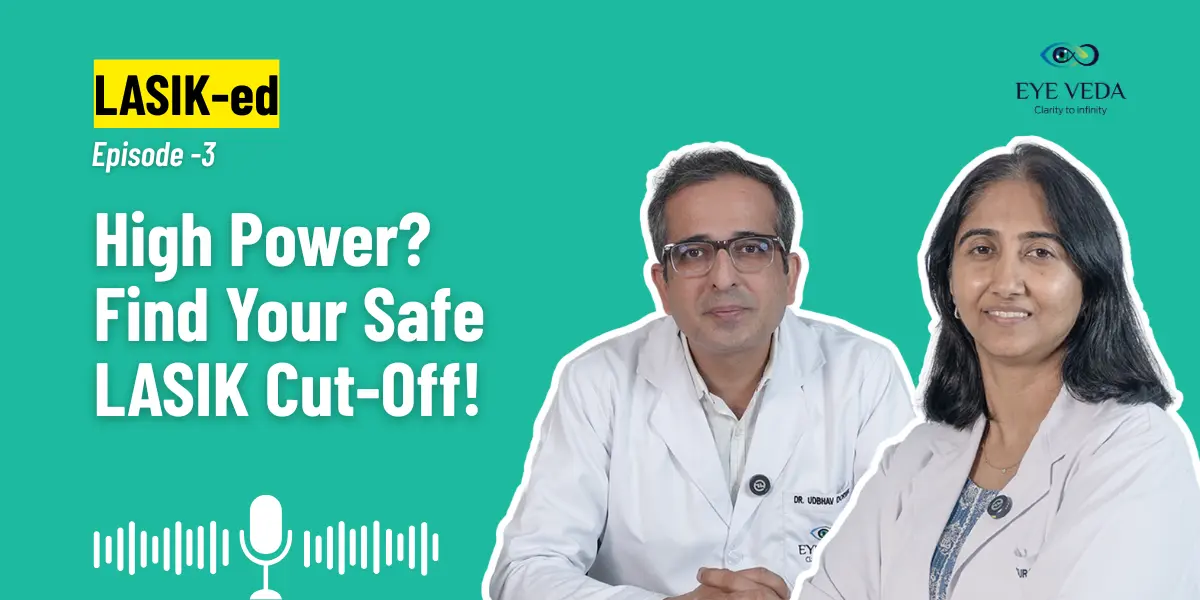
If you’re considering LASIK surgery to finally ditch your glasses, a common question is: ‘Can LASIK treat my prescription, especially if I have very high eye numbers?’ This is a critical safety question. In this episode of ‘LASIKed,’ Dr. Surabhi and Dr. Udbhav from Eye Veda Hospital break down the maximum power limits for LASIK, why these cut-offs exist, and what factors—like corneal thickness—play a crucial role in deciding your eligibility. They emphasize that while LASIK is transformative, patient safety is paramount, and there is a definite upper limit to what the procedure can safely correct. Watch the full video below to get all the details!
| Refractive Error | General Upper Limit for LASIK Correction | Key Safety Rationale |
| Myopia (Minus Number) | Up to -7 to -8 Diopters | Prevents the cornea from being excessively thinned, which could cause it to protrude and lead to the power coming back. |
| Hyperopia (Plus Number) | Up to +3.5 to +4 Diopters | The cut-off is lower as the procedure still requires adequate residual corneal tissue. |
| Astigmatism (Cylinder) | Must be assessed in combination with sphere. | The combined total effective power is what determines eligibility. |
Why LASIK Has Power Limits
The primary reason for these strict cut-offs is to maintain the long-term structural integrity of the eye. LASIK works by using a laser to remove microscopic tissue from the cornea (the eye’s clear front surface) to reshape it. For very high numbers, too much tissue must be removed, which leaves the cornea dangerously thin.
A thinner-than-safe cornea can become weak, causing it to bulge outward, which is known as ectasia, and can lead to the return of myopia (minus numbers).
The Most Crucial Factor: Corneal Thickness
While the power of your prescription is important, Dr. Surabhi and Dr. Udbhav stress that eligibility for LASIK is not solely about the number. The corneal thickness is a non-negotiable factor.
- If a patient has a moderate power (e.g., -4), but their cornea is naturally thin, they would still be considered unfit for LASIK.
- Detailed reports, such as Pentagram reports, are essential for the surgical decision-making process.
What Are the Options for High Power Patients?
If your prescription falls outside the safe LASIK range (e.g., -5 with a -3 cylinder, making it a very high total effective number, or if you have a thin cornea), the recommended alternative is often ICL (Implantable Collamer Lens). ICL is an additive procedure where a specialized lens is placed inside the eye, working with the natural lens, rather than removing tissue from the cornea. This makes it a much safer modality for patients with high refractive errors.
Contact Us for Best LASIK treatment
Ready for the Best LASIK Treatment in Delhi? Get in touch with Eye Veda Hospital and get a free LASIK check-up.
Visit Us: 📍 GF, E5, Block E, Defence Colony, Delhi – 110024
Call Us: 📞 +91-8800433050
Email Us: ✉️ [email protected]
Leave a Reply